If only I’d cracked the code of attachment styles 15 years ago, I might’ve dodged a string of heartbreaks that looked like love at first—but were really trauma dressed in charm. Maybe I wouldn’t be here now, picking up the scattered pieces of myself like a jigsaw puzzle, trying to make sense of it all.
But I didn’t know.
And now—I’m here. becoming wiser, stronger, and more resilient; while still healing. I am beginning to understand that maybe I wasn’t too much. Maybe I was just choosing people who couldn’t meet me where I was emotionally. Today, I completed Attached by Amir Levine and Rachel Heller, and it felt like someone handed me both a flashlight and a mirror. Suddenly, years of confusion started to make sense. The way I loved. The way I feared. The way I clung. The way I blamed myself. Even the manner in which I have been presenting myself recently in my current circumstances. I have discovered that I have an anxious attachment style—and looking back, I have been in relationships with avoidant and disorganized partners. What I’ve come to understand after completing this book today is that I am not “crazy”. I am not “broken”. I have merely found myself trapped in a cycle I couldn’t comprehend.
Let’s start with the basics.
What Are Attachment Styles?
Attachment styles are the emotional blueprints we carry into our adult relationships. They’re shaped by early interactions with caregivers and define how we connect, communicate, and respond to love, conflict, and closeness.
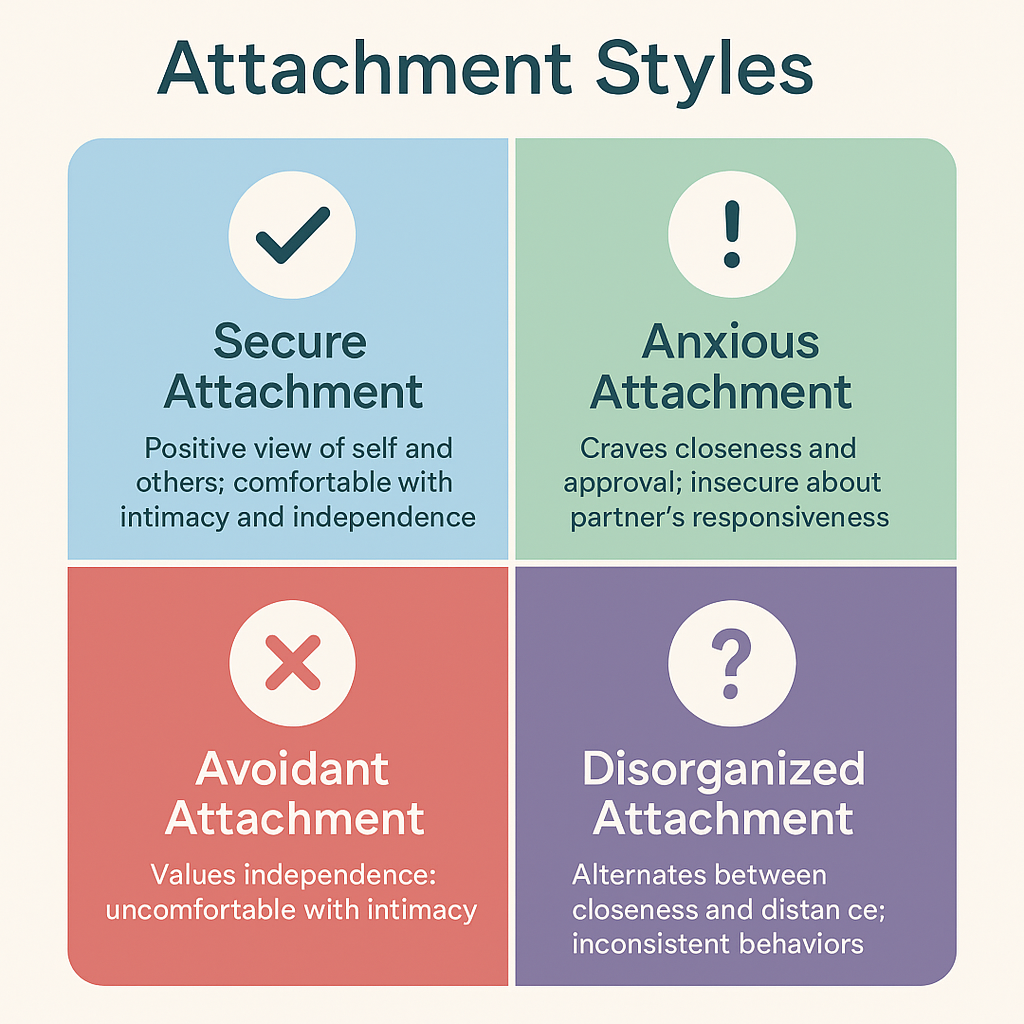
There are four main types:
1. Secure Attachment
These individuals have a healthy balance of closeness and independence. They trust easily, communicate openly, and don’t fear abandonment. For example, when something feels off in a relationship, a secure person will address it calmly instead of spiraling or shutting down.
2. Anxious Attachment (My attachment style)
People with an anxious style crave closeness and constant reassurance. Silence feels like punishment. Distance feels like danger. If a partner doesn’t text back quickly, their mind races: Did I do something wrong? Are they leaving?The fear of abandonment drives the need to prove worth, even when it’s not required.
3. Avoidant Attachment
Avoidant individuals value independence so much that intimacy feels suffocating. They tend to withdraw emotionally when relationships deepen. Their partners often feel neglected, confused, or starved for connection. Vulnerability is uncomfortable territory for avoidants, and they’ll often keep walls up—even in love.
4. Disorganized Attachment
Disorganized attachment is rooted in unresolved trauma or inconsistent caregiving. These individuals crave closeness but fear it simultaneously. They swing between hot and cold, intimacy and retreat. For their partners, it can feel like emotional whiplash.
How I Became Anxiously Attached
My anxious attachment style wasn’t born in adulthood—it was built, brick by brick, in my childhood. I grew up feeling like love had to be earned. One parent was absent, emotionally and physically, during my most formative years. The other was stretched thin—doing their best, but often unavailable. I wasn’t nurtured consistently. I wasn’t seen. I wasn’t celebrated. I was surviving, not thriving. I learned early on that attention was conditional. That love might disappear. That my voice could go unheard. So I hustled—for affection, for validation, for someone to notice me. I tied my worth to how needed I was, how accommodating I could be, how perfectly I could perform the role of “enough.” That little girl didn’t feel chosen, so the grown woman chased after anyone who might choose her.
In relationships, it looked like this:
If my partner didn’t say “good morning,” I questioned my value.
If we argued, I’d panic and say, “Just leave then,” bracing for abandonment before it could hit me first.
I interpreted distance as danger. I equated conflict with being unloved.
I was trying to protect myself. But in doing so, I often sabotaged the very connection I craved and it was only today that I came to this realization.
Anxious + Avoidant = The Push-Pull Nightmare
Looking back, my last two relationships were textbook case studies in attachment dysfunction. One partner was avoidant, the other disorganized. Both were disasters waiting to happen—especially for someone with anxious tendencies like mine. With the avoidant, I was always “too much.” Too emotional. Too needy. Too available. They wanted space, I needed closeness. I chased. They retreated. The harder I tried to connect, the more they shut down. We were locked in a toxic dance: me clinging, them escaping.
With the disorganized partner, it was chaos wrapped in chemistry. One minute, they wanted to hold me tight. The next, they pushed me away. I was constantly on edge—trying to decode their emotional weather. I’d walk on eggshells, trying not to trigger their disappearance. Their unpredictability mirrored my childhood, and my nervous system read it as love. But it wasn’t love. It was survival mode. And I was exhausted.
I have drained myself trying to invest all my love into my relationships, neglecting to extend that same affection toward myself. Have I shown myself love? Yes, but there have been times when I chose to overlook my own needs for the sake of the person I was with. I often felt depleted yet continued to give more. I hoped that by pouring into them; they knew I loved them. All the while, I was in a relationship with the wrong attachment style. It wasn’t wrong to desire cuddles, engage in daily conversations, express love through gifts, or plan spontaneous surprises; I simply directed these gestures toward the wrong individuals with incompatible attachment styles.
The Truth That Changed Everything
Learning about attachment theory will not only enhance my understanding of others, but it will also help me reclaim parts of myself. I will stop labeling myself as “too sensitive” and instead recognize that I am emotionally attuned. I will no longer idealize emotionally unavailable men. Instead, I will start the process of grieving the years I spent diminishing myself to earn the affection of those who didn’t even know how to love themselves.
Here’s what I know now:
🟣 Love should feel safe, not suspenseful.
🟣 Affection shouldn’t come with anxiety.
🟣 And being seen shouldn’t be something you fight for—it should be automatic.
What Now? A New Standard of Love
Now that I understand my anxious attachment style, I’ve set new standards for love:
• I will not chase people who can’t show up for me emotionally.
• I will not interpret silence as a challenge to fix, but as a red flag.
• I will honor my need for consistency and reassurance—without apology.
I also think I might prefer an anxious attachment style in my future partner, even if that sounds a bit cliché! Some might say two anxious types shouldn’t date—but maybe we could thrive together, because we get each other’s wounds. We know what it feels like to fear abandonment. We know how to offer presence, not punishment. I am also open to the idea of dating a secure partner, because a secure individual will be inclined to grow together. What I truly desire is someone who has a relationship with God and is prepared and eager to evolve alongside me.
Because real love isn’t built on chaos.
It’s built on clarity.
On calm.
On two people saying: “I see you—and I’m not going anywhere.”
Final Thoughts: From Pain to Power
To anyone untangling the wreckage of mismatched relationships: you’re not broken. You were likely just trying to love with a blueprint that didn’t match theirs. That doesn’t make you weak—it makes you human.
But now, you know better.
And when you know better, you choose better. You become the partner you’ve been looking for. You stop auditioning for love and start requiring it to show up whole.
So, take hold of that mirror. Shine the flashlight on your behaviors. Examine your patterns, not to cast shame upon yourself—but to liberate yourself.
Because the love you deserve?
It doesn’t leave you guessing.
It doesn’t disappear when things get hard.
It holds you steady—and says, You are safe here.
And I can’t wait to experience that love too…. -Shell

Leave a comment